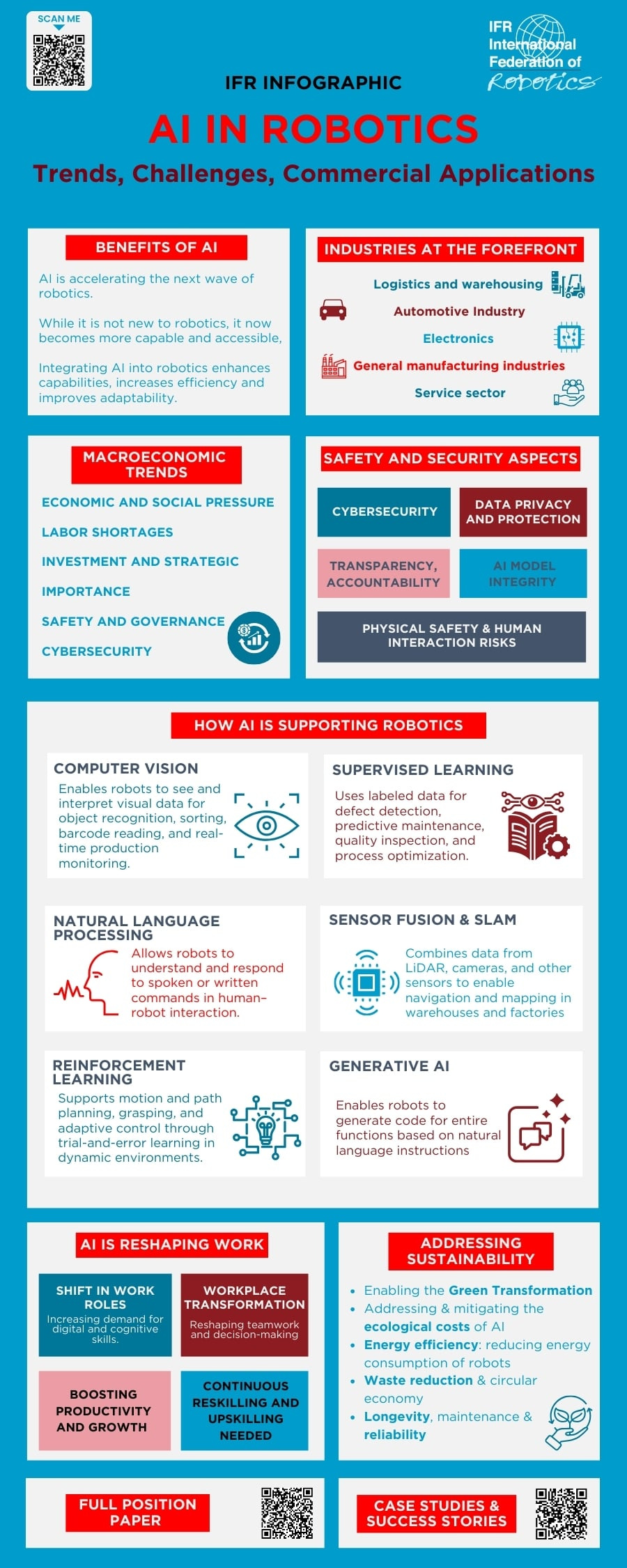
AI is rapidly boosting robots’ capabilities, efficiency and adaptability on factory floors and in service settings, the International Federation of Robotics (IFR) argues in a new position paper.
IFR highlights how deep-learning computer vision now allows robots to see and interpret visual data for tasks such as object recognition, barcode reading, sorting and real-time production-line monitoring, while supervised learning powers defect detection, predictive maintenance, quality inspection and process optimisation. Natural-language processing lets collaborative and service robots understand and respond to spoken or written commands, and mobile robots blend data from cameras and LiDAR to perform simultaneous localisation and mapping for warehouse and shop-floor navigation.
AI for robotics promises to bring the productivity improvements seen from generative AI to the physical world, even as governments and boardrooms alike try to balance the gains from AI-enabled automation with unease over jobs, safety and the energy appetite of large models.
Robot installations are already taking over physically demanding and repetitive tasks, freeing workers from harsh conditions, even as AI adds demand for data scientists, machine-learning specialists and ethicists, and forces companies and employees to keep re-skilling to remain competitive. At the same time, the IFR notes, AI-enhanced efficiency and output may spur economic growth while intensifying pressure on businesses and workers to adapt to faster cycles of technological change.
“In future, AI in robotics will further influence how teams work, how decisions are made, and how performance is monitored,” the IFR notes, adding that improved workflows “may also raise concerns about employee surveillance or reduced autonomy.”
The federation notes that reinforcement learning, though still emerging in industrial settings, is gaining traction in motion and path planning, grasping and adaptive control, where robots learn by trial and error in dynamic environments. It singles out generative AI as the next step, predicting that models will generate code for entire robotic functions from natural-language instructions. The quality of AI-generated code should be rigorously tested IFR adds.
Developers and users, it cautions, must contend with data poisoning, biased or compromised training sets and the unpredictability of autonomous systems, since malfunctions in the physical world can have more severe consequences and human-robot collaboration must remain physically safe at all times. A growing focus on sustainability will push robotics towards efficiency and longer robot lifespans, the IFR says, even as the sector confronts the ecological cost and carbon footprint of training large AI models.