
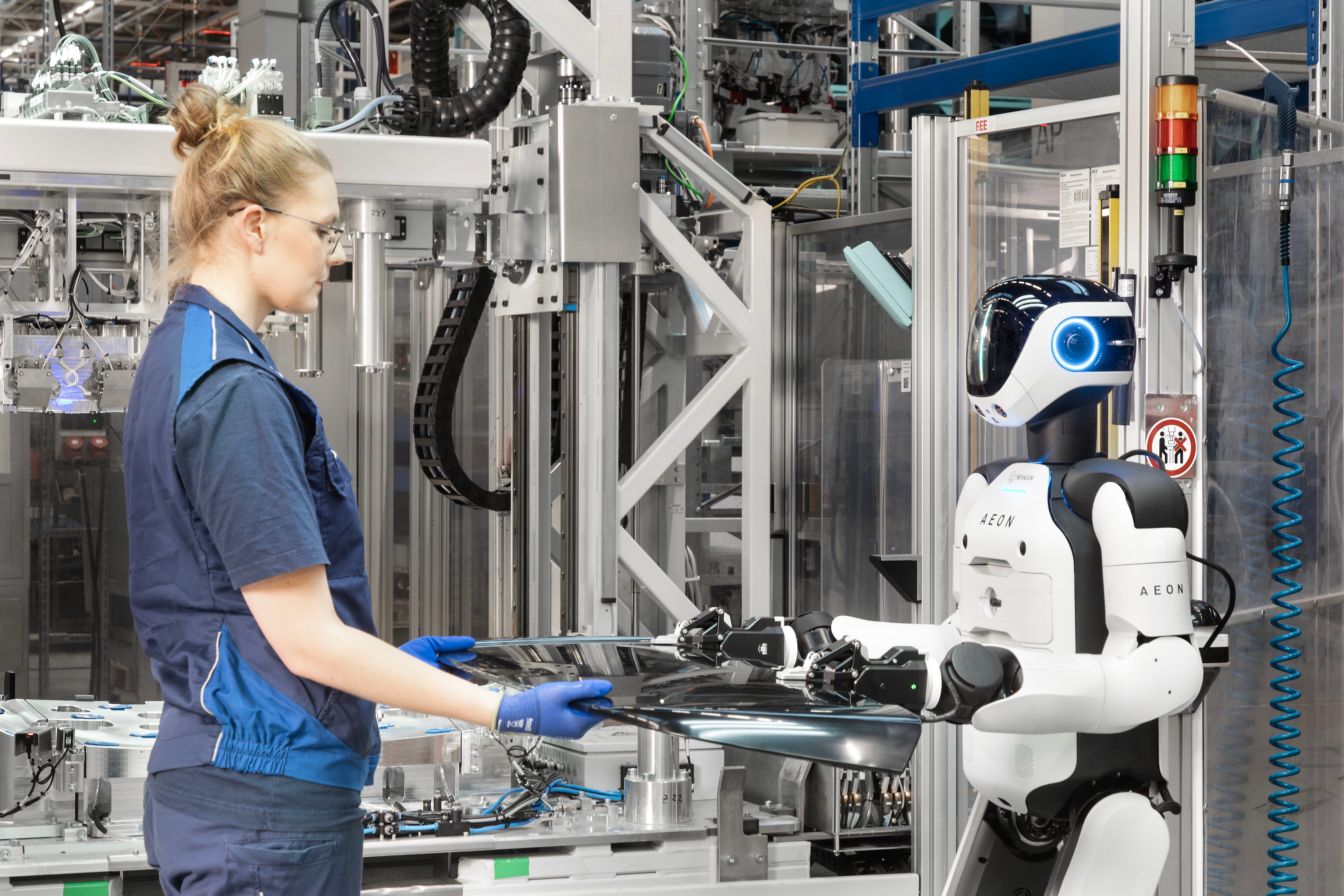
BMW Group is bringing humanoid robots into series production in Germany for the first time, extending an ambitious push to fuse artificial intelligence with factory automation. The carmaker will run a pilot at its Leipzig plant using AEON, a humanoid robot developed by long-standing partner Hexagon, to support assembly of high‑voltage batteries and component manufacturing from summer 2026.
The move follows a 2025 trial in Spartanburg, South Carolina, where Figure AI’s Figure 02 robot handled precise, repetitive body‑shop tasks in BMW’s X3 production line. Over ten months, Figure 02 worked ten‑hour shifts, five days a week, moving more than 90,000 sheet‑metal components and supporting the production of over 30,000 vehicles, while integrating with BMW’s existing smart transport robots and robotics ecosystem.
Automakers and technology groups are racing to deploy humanoid robots as labour markets tighten, vehicle architectures grow more complex and traditional industrial automation reaches its limits. Proponents argue that mobile, human‑shaped machines, powered by increasingly capable AI systems, can slip into brownfield plants, take on ergonomically punishing or safety‑critical tasks and be reprogrammed as models and processes change, potentially reshaping factory work in the same way industrial robots did in the late 20th century.
“Digitalisation improves the competitiveness of our production – here in Europe and worldwide. The symbiosis of engineering expertise and artificial intelligence opens up entirely new possibilities in production,” said Milan Nedeljković, BMW’s production chief.
BMW describes the initiative as part of a broader “Physical AI” strategy that combines digital AI agents, a unified data platform and robots able to learn and operate autonomously on the shop floor. It has created a Center of Competence for Physical AI in Production in Munich to vet technology partners, run lab‑based evaluations with real use cases and then move promising systems into plant‑level pilots.
At Leipzig, AEON will be tested as a multifunctional platform whose human‑like form factor can carry different grippers and scanning tools and move dynamically on wheels. The emphasis, BMW says, is on complementing existing automation, taking over monotonous and physically demanding tasks, and improving working conditions rather than replacing staff.
“Our aim is to be a technology leader and to integrate new technologies into production at an early stage,” said Michael Nikolaides, who oversees BMW’s global production network and supply chain.