

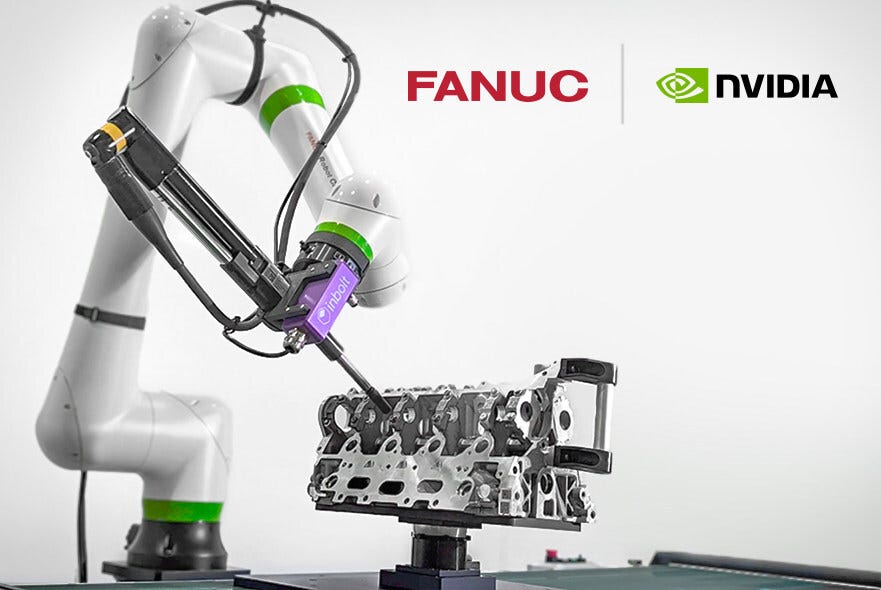
FANUC has moved to bind its industrial robots more closely to Nvidia’s simulation and computing stack, in a sign that factory automation is edging toward a more software-defined future. The Japanese group says the partnership will combine its robot hardware and ROBOGUIDE software with Nvidia’s Jetson modules, Isaac Sim and Omniverse libraries.
The immediate appeal is practical in that manufacturers are under pressure to shorten commissioning time, reduce errors and cope with more variable production runs. Digital twins offer a way to test changes before steel is cut or a line is halted. FANUC expects the arrangement will let customers create photorealistic factory replicas, train robots virtually and deploy them with greater speed and flexibility.
Across the industrial world, the race is shifting from merely supplying robots to making them easier to simulate, program and adapt at scale. That matters because physical AI – a phrase now gaining currency increasingly to mean software that can imbue intelligence into machines – promises to merge perception, reasoning and motion in a way that could make robots more useful in automotive plants, logistics hubs and food-processing lines, where variability still frustrates automation.
“Physical AI is the next frontier in industrial automation,” said Mike Cicco, President and CEO, FANUC America. “By collaborating with NVIDIA, we’re giving manufacturers the tools to deploy intelligent robotics faster and align virtual design with real-world production.”
“Manufacturers are increasingly seeking physical AI solutions that bridge the gap between virtual simulation and real-world production to overcome labor shortages and increase operational efficiency,” said Murali Gopalakrishna, general manager of robotics at NVIDIA. “By integrating NVIDIA’s AI and simulation platforms with FANUC’s robotics expertise, we are providing developers with the tools to build and deploy intelligent, adaptable automation at scale.”
The collaboration will advance physical AI — a new paradigm that merges artificial intelligence with physical robotics to enable “machines that see, reason, and act in dynamic environments,” the company said in a press release.
Under the collaboration, FANUC will use NVIDIA AI infrastructure “within its extensive robot portfolio and ROBOGUIDE simulation software,” according to the release. It added that integrating ROBOGUIDE with Isaac Sim and Omniverse would allow manufacturers to “simulate entire production lines with high fidelity, validate workflows, and optimize performance before hardware deployment, reducing commissioning time and cost.”
FANUC also said combining its robots with Jetson and AI-accelerated computing would help machines “adapt to variability, execute complex tasks, and deliver higher throughput”.
Companies such as FANUC face the challenge of continuing to maintain their reputation for reliability, while at the same time ensuring that they don’t fall behind in adapting just the right levels of AI to make their robots genuinely useful in real-world scenarios.