
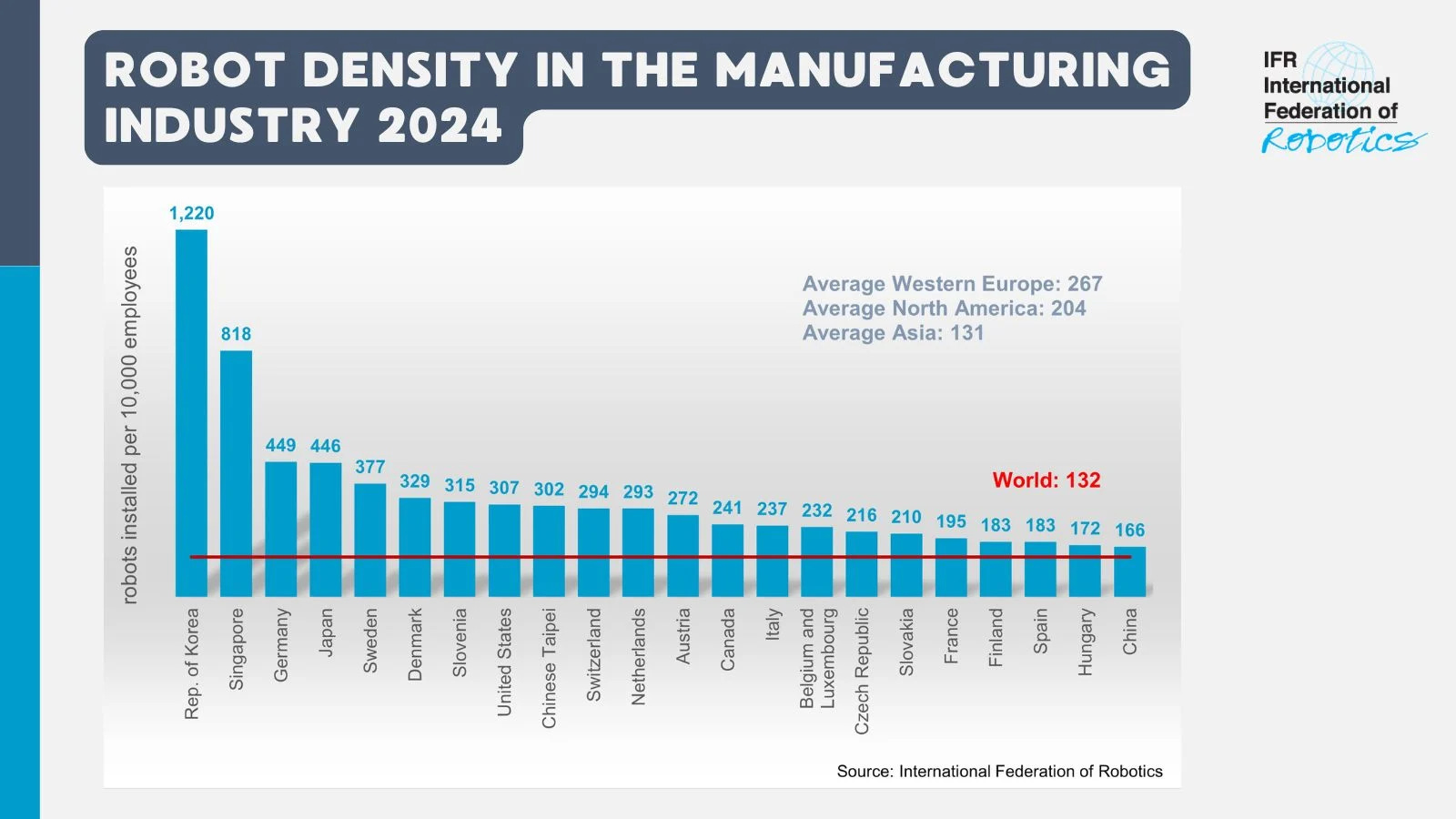
Industrial automation is accelerating as economies worldwide prioritise the integration of factory robots to bolster productivity. According to the World Robotics 2025 report by the International Federation of Robotics (IFR), Western European countries reached a record density of 267 robots per 10,000 manufacturing employees in 2024. This figure places the region ahead of North America, which recorded 204 units, and Asia, which averaged 131 units.
The European Union maintains a robot density of 231 units, significantly above the global average of 132. Within the region, Germany remains the primary driver, ranking third globally with 449 units per 10,000 employees, following an average annual growth of 5 percent since 2019. Other European nations in the global top ten include Sweden, Denmark, and Slovenia.
The global surge in automation reflects a fundamental realignment of industrial strategy as nations grapple with tightening labor markets and the imperative for supply-chain resilience. In an era where demographic decline and rising costs threaten traditional manufacturing models, robot density has emerged as a critical indicator of an economy’s ability to maintain its industrial edge without relying on a growing pool of human labor.
“The robot density metric provides a uniform basis for comparison by relating the total number of robots used in a country to its economic size, as measured by its workforce,” Takayuki Ito, President of the International Federation of Robotics, said in a post.
The Republic of Korea maintains the world’s highest robot density with 1,220 robots per 10,000 employees, benefiting from its dominant electronics and automotive sectors. Singapore follows in second place with 818 units, while Japan ranks fourth with 446. The United States ranks eighth worldwide with 307 units, representing a 4 percent year-on-year increase.
However, the most significant shifts are occurring in China. Although its density ranks 22nd globally at 166 units, its operational stock of 2 million units is the largest in the world — approximately 4.5 times that of Japan. In 2024 alone, China accounted for 54 percent of all global robot installations, deploying 295,000 units as it seeks to automate its vast manufacturing base.