
Autonomous mobile robots are gaining traction in warehouses and factories worldwide. Their long-term success depends not just on software wizardry but equally on hardware fundamentals.
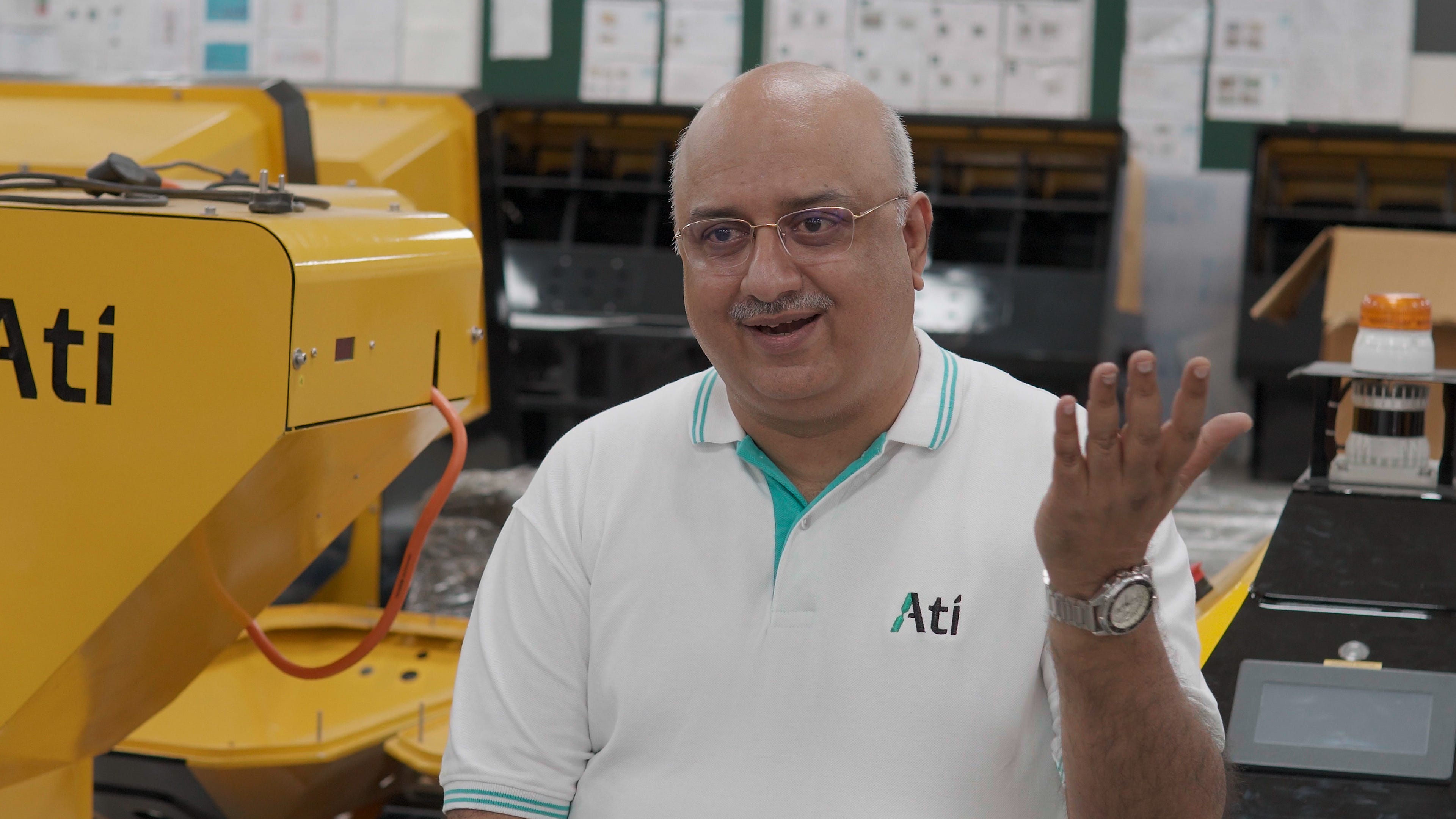
In a recent conversation with Mobile Robotics Insider, Venkatesh Prasad BS, Head of Mechanical Engineering at Ati Motors, offered some insights into how mechanical design determines whether these machines perform reliably in demanding industrial environments.
His perspective, shaped by nearly three decades in product design across machine tools, forklifts, and mobile robotics, emphasises deliberate engineering over technological flair. Here are five takeaways from his conversation.
1. Design for reliability, not iteration
The philosophy at Ati Motors departs from the Silicon Valley mantra of rapid iteration and learning from failure. Venkatesh argues that in autonomous mobile robots, mistakes cannot be afforded. “It is fine initially, but now we cannot afford to do mistakes,” he notes, describing the shift from a learn-as-you-go approach to a “do it right first time” methodology. This stems from practical economics: fixing errors escalates exponentially as products move from design to prototype, pilot production, and field deployment. A design flaw discovered in a warehouse costs far more to remedy than one caught during engineering reviews.
This approach requires extensive upfront planning. The mechanical engineering team at Ati conducts thorough market studies, customer benchmarking, and competitive analysis before committing resources. They identify technical risks early and address components with long lead times to avoid delays in production readiness. The discipline extends to testing. When choosing between a linear ball bearing and a polymer bearing for suspension mechanisms, engineers build test setups to validate life cycles before finalising designs. Testing runs parallel to design rather than following it, compressing development timelines without sacrificing rigor.
2. Adaptability through materials and structure
Autonomous mobile robots operate in environments that vary considerably — smooth factory floors, rough outdoor concrete, wet surfaces, uneven terrains. Mechanical designs must accommodate these conditions without requiring multiple product variants. At Ati, this translates into selecting drive systems, protective enclosures, and structural materials that withstand diverse stresses.
Prasad describes the use of lightweight yet durable materials such as glass fibre and carbon fibre. These composites reduce the robot’s overall weight, lowering power consumption while maintaining structural strength. They resist corrosion, dampen vibration, and offer an additional benefit: transparency to Wi-Fi signals, which metal enclosures would otherwise block. Material selection extends beyond performance specifications. Load-carrying members undergo heat treatment for strength, and critical components are machined to tight tolerances to ensure accuracy in the tolerance stack—the cumulative effect of part variations on assembly performance.
The outer chassis provides protection against dust, impacts, and water splashes. Coatings prevent rust and wear. Moving parts are covered, and bumpers with sensors prevent collisions. These are not aesthetic choices but functional requirements for robots expected to operate continuously in harsh conditions.
Small details matter. Bolts, for instance, must be tightened to specified torques. You have made a fantastic vehicle, but you don’t tighten the bolts. That’s a bad failure point.
3. Powertrain optimisation and energy efficiency
Transmission efficiency determines how long a robot operates between battery charges. Venkatesh explains that optimising the powertrain involves more than selecting a high-quality gearbox with low backlash. It requires attention to every component connecting the motor to the wheel—shafts, couplings, bearings, and fasteners. Engineers select appropriate grades of steel and aluminium and specify manufacturing processes to minimise friction and energy loss.
Small details matter. Bolts, for instance, must be tightened to specified torques. “You have made a fantastic vehicle, but you don’t tighten the bolts. That’s a bad failure point,” he observes. Battery management strategies also contribute to efficiency. Ati’s robots support both manual and automated battery swapping, depending on customer requirements and available downtime. Opportunistic charging allows robots to recharge during lunch breaks or shift changes, extending operational hours without dedicated charging cycles.
Failsafe mechanisms add redundancy without compromising efficiency. Ati’s Sherpa robots incorporate brakes that engage automatically if power is lost, preventing unintended movement and ensuring safety in warehouses where human workers are present.
4. Modularity and platform reuse
Modular design reduces development time and cost while increasing product versatility. Prasad cites the Sherpa 500 as an example — a modular platform that transforms into different configurations by changing top modules. It can lift payloads, move items on conveyors, or perform turning operations. The Sherpa Mecha, a humanoid robot built on the same chassis, uses interchangeable grippers for tasks ranging from pick-and-place to assembly and testing.
Platform reuse accelerates product launches. When Ati identified demand for a compact robot capable of navigating narrow factory aisles, engineers adapted the Sherpa Pivot — a robot designed for assembly line movement—by adding forks to create a miniature pallet mover. The modification enabled fast deployment in production lines where larger pallet movers could not operate. “This was brought because of the small change that we did to existing vehicle and it went into production like very fast,” he explains.
Modularity also addresses diverse customer requirements. Pallet sizes vary by width, length, and construction (open or closed stringers), and materials range from wood to steel. Fork-to-fork distances can be adjusted for stability across different pallet types. Tilt angles allow loads to rest against the chassis during high-speed transport, improving stability. The challenge lies in designing one product that meets multiple needs without becoming overly complex or sacrificing robustness.
5. Cross-functional integration from the start
Mechanical, electrical, and software teams at Ati collaborate from the outset of product development rather than working sequentially. Venkatesh describes this as concurrent engineering, where system engineers understand customer requirements, design constraints, and manufacturing capabilities simultaneously. If the control team requires high positional accuracy, the mechanical team optimizes steering, gearbox, wheels, and suspension to deliver precision, reducing the burden on software to compensate for mechanical imprecision.
This approach resembles a band fine-tuning instruments together rather than rehearsing separately. Problems are identified and resolved early, before they cascade into costly redesigns. Every engineer understands that delays in new product delivery mean losing first-mover advantage. The team focuses resources on select products to ensure timely completion rather than spreading efforts thinly across multiple projects.
Concurrent engineering shortens development cycles and matures products faster, meeting customer deadlines without compromising quality. Venkatesh emphasizes that all engineers at Ati grasp the value customers derive from their products and design with manufacturability in mind from day one.
