
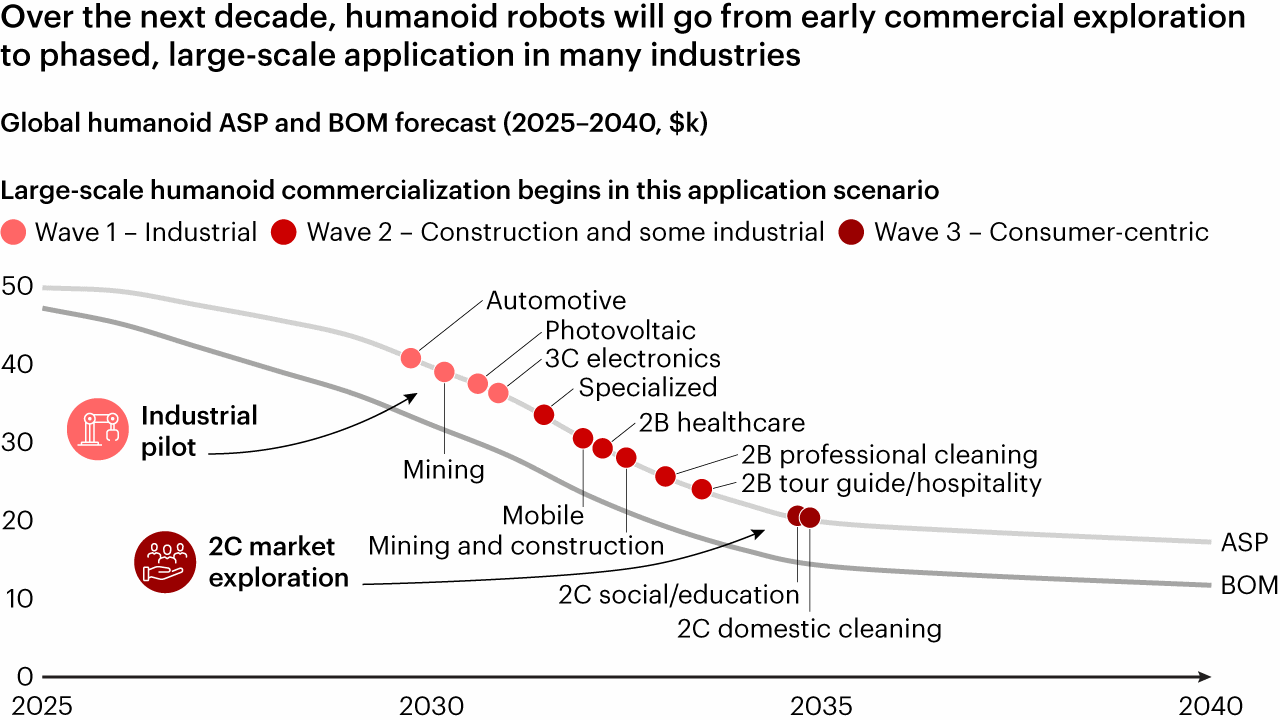
Humanoid robots, long a staple of science fiction, are edging closer to commercial reality as companies begin structured trials in factories, warehouses and commercial buildings, according to new analysis from Bain & Company. The consultancy argues that the timing and scale of adoption will depend less on gee-whizz demonstrations and more on prosaic factors such as power systems, sensor density and measurable returns on investment.
Bain says the technology stack for humanoids is progressing unevenly: intelligence and perception are advancing quickly but are still short of enabling fully autonomous operation, while power systems and dense, reliable sensing remain stubborn bottlenecks. Large-scale penetration, it contends, will only come once those constraints ease, safety and privacy concerns are addressed, and early adopters can prove positive returns that justify broader rollout.
Behind the cautious timeline lies a bigger wager about the future of work and automation. Over the next decade, Bain expects humanoid robots to move from experimental deployments to large-scale use across three successive waves —industrial, commercial and then consumer — potentially reshaping labour-intensive sectors from automotive and mining to healthcare, hospitality and domestic services.
Their spread will test how quickly firms, regulators and workers are willing to trust machines that look and move like people, yet are designed to slot into tightly optimised workflows rather than to replace humans wholesale.
“Humanoid robots are on the way, but their success depends as much on economics and trust as on technology,” the report concludes.
In Bain’s schema, early industrial use cases span automotive production, mining and construction, where humanoids can step into dangerous, variable or ergonomically awkward tasks that traditional fixed or wheeled robots struggle to handle. Our analysis of industrial humanoid deployments at BMW and Toyota examines how this first wave is playing out on factory floors today.Commercial settings such as professional cleaning, healthcare and hospitality — tour-guide roles among them — are expected to follow as software improves and operators gain confidence.
Consumer adoption, in areas such as domestic cleaning and education, is likely to lag until costs fall and reliability is proven in harsher industrial environments. Bain foresees a hybrid future in which non-humanoid machines handle highly repetitive workflows, while humanoid robots act as “flexible generalists” alongside humans, who focus on strategic oversight such as planning, workflow orchestration and risk management.