

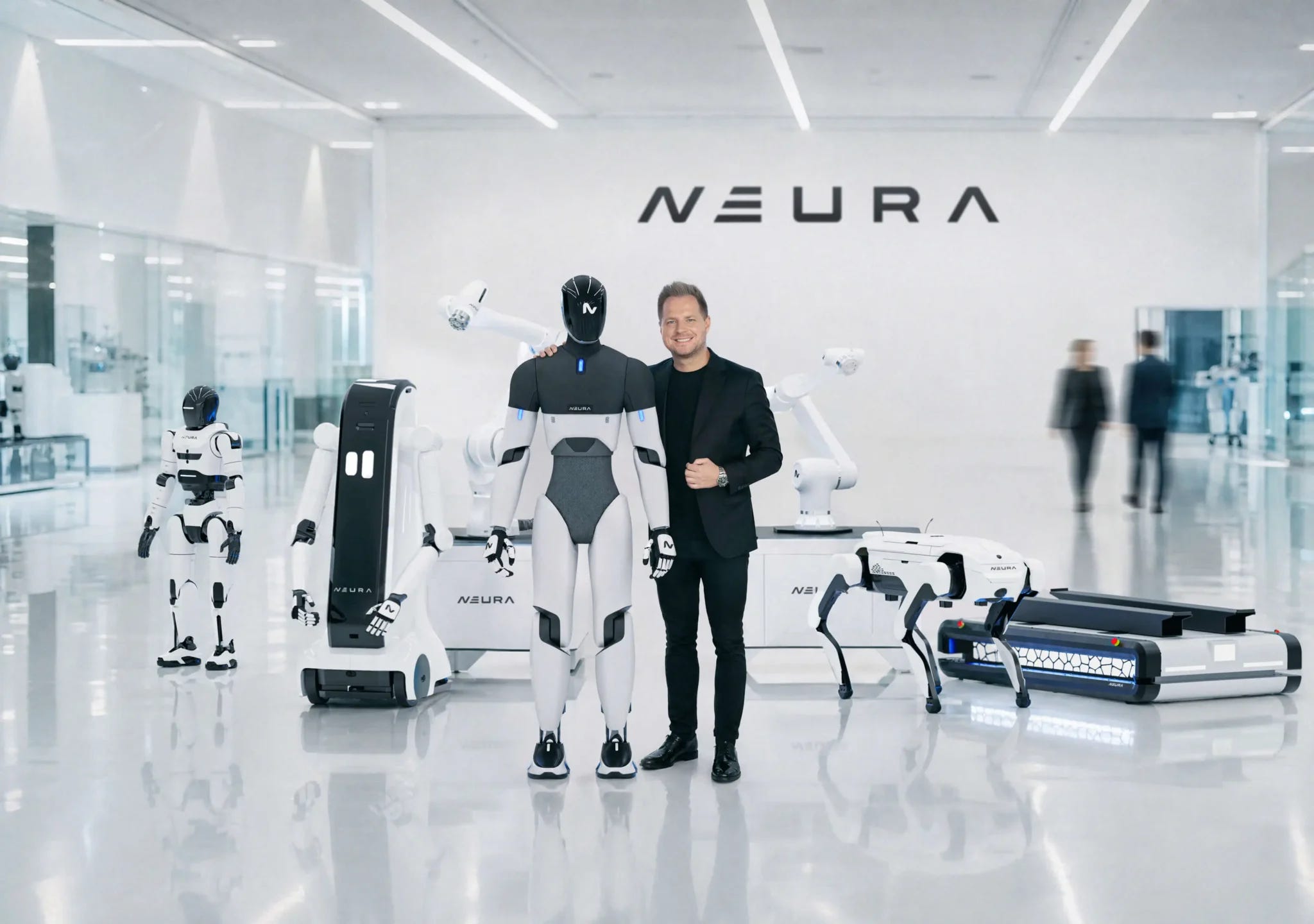
NEURA Robotics has raised up to $1.4 billion in a Series C round, a sum that underscores how quickly “physical AI” has become investable shorthand for the next phase of robotics. The German company says the capital will help it scale its cognitive robots, expand production and push its platform deeper into industry.
The investor list is broad, spanning Tether, Qualcomm, Amazon, Nvidia, Bosch, Schaeffler, the European Investment Bank, imec.xpand, Lingotto Horizon and InterAlpen Partners. NEURA frames the round as a backing for a full-stack approach in which hardware, software and data are developed together, rather than assembled piecemeal.
The wider significance is clear: as AI investment shifts from chatbots and cloud software to machines that act in the physical world, robotics firms are being valued less like niche manufacturers and more like strategic infrastructure. That is why NEURA’s raise matters beyond Germany. It sits at the intersection of industrial automation, semiconductor ambition, logistics demand and a broader race to commercialise robots that can learn, adapt and be deployed at scale.
“The future of AI will not only live on screens,” said David Reger, Founder and CEO of NEURA Robotics. “It will move, interact, learn and work beside us in the real world. We believe Physical AI and cognitive robotics will become one of the largest technology shifts of the coming decades, transforming industries ranging from manufacturing and logistics to healthcare, services and household robotics.”
NEURA says it already has an order backlog and strategic deployment pipeline above $1 billion, and it aims to use the fresh money to lift production capacity sharply, with a longer-term target of shipping millions of robots by 2030. Bloomberg has reported that the round could value the company at about $7 billion, though NEURA itself has not publicly confirmed that figure.
The company’s pitch is straightforward: if AI is to move from screens into factories, warehouses and homes, the winners will need more than good models. They will need robots that can be manufactured, trained and sold at industrial scale.