

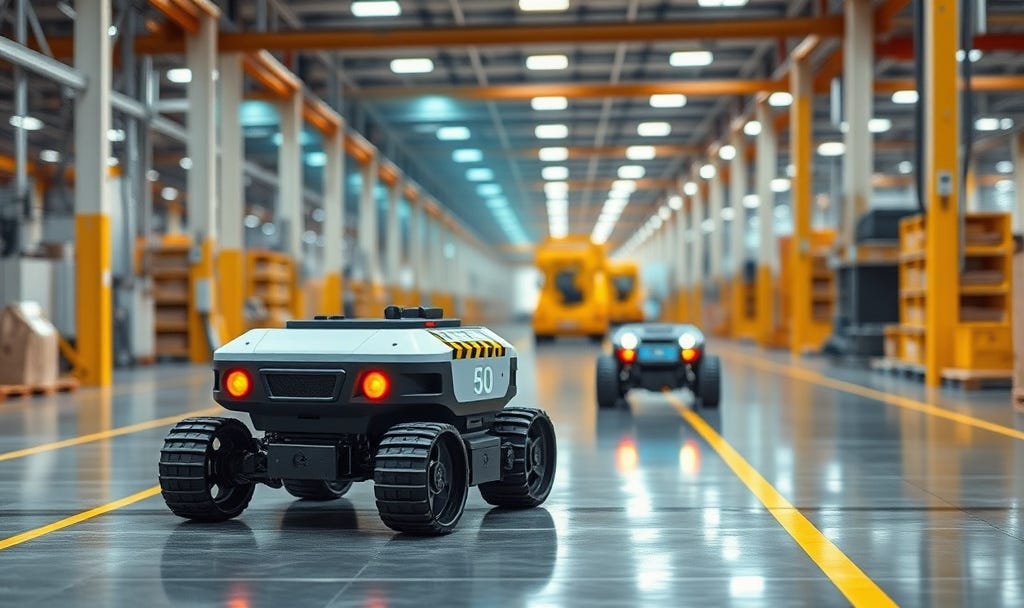
The future of industrial automation surely involves the fairly straightforward idea of machines that see understand, and act. Yet the path from rudimentary obstacle detection to genuine spatial awareness has proven far more complex than early predictions suggested.
Today, as factories and warehouses worldwide face mounting labour shortages and efficiency demands – simultaneously attempting to move from single-purpose assemblies to flexible operations – the critical enabler of practical autonomy is not just more robots. It is robots that perceive their world accurately, navigate reliably, and operate safely alongside human workers.
This transformation hinges on advances in 3D sensor technology and its integration into unified perception systems. The stakes are substantial. A single collision in a warehouse can cascade into lost productivity, equipment damage, and even injury to humans. If we are to go from limited automation that won’t scale and may even prove a liability to automation that truly scales, we need to go from robots that only execute pre-programmed paths and those that adapt to unforeseen obstacles.
The perception problem
Consider what autonomous industrial robots must accomplish. They must detect people and objects in cluttered environments. They must function in harsh conditions — rain, dust, varying light, oil spills on factory floors. They must operate continuously, safely, and with minimal human intervention. Traditional 2D vision systems struggle with these demands. They fail in low light, lose efficacy with reflective surfaces, and require extensive computational overhead to infer depth. Automated guided vehicles (AGVs) confined to magnetic strips or reflective markers represent an earlier era of inflexible automation.
The advent of 3D sensing technologies — LiDAR, structured light, and time-of-flight cameras—has fundamentally altered what is technically feasible. LiDAR sensors generate point clouds with centimetre-scale accuracy across wide fields of view, even in complete darkness. Time-of-flight systems operate with lower latency and compact form factors, well suited to mobile platforms. Structured light offers high resolution in controlled environments. Yet deploying any single sensor modality across diverse industrial settings remains insufficient.
This reality has spawned a new discipline: sensor fusion. Rather than relying on one sensor, advanced autonomous systems now integrate data from multiple sensor types—cameras, LiDAR, ultrasonic sensors, inertial measurement units—to construct a more complete environmental model. When a camera struggles with glare, radar compensates.
When LiDAR performance degrades in rain, thermal imagery provides alternatives. The redundancy not only improves accuracy but serves a critical safety function: no single sensor failure can cascade into a collision.
The navigation challenge
The question of how a robot knows where it is, where it is going, and how to get there remains fundamentally difficult. Simultaneous localisation and mapping (SLAM) — the process of building environmental maps while simultaneously tracking position within them — depends entirely on the quality of sensor data flowing into the algorithm. A robot equipped with only low-resolution depth sensors cannot map fine details or detect small obstacles. One relying solely on visual odometry may fail when texture-less surfaces or rapid movement occur.
Advanced industrial robots now employ multi-modal SLAM systems that leverage complementary sensor strengths. Real-time processing of this fused data occurs at the edge — directly on the robot itself —rather than relying on cloud connectivity. This matters practically: a warehouse robot cannot pause for latency when navigating toward a moving pallet.
Edge computing, accelerated by various emerging computing platforms, enables perception pipelines running at 60 frames per second or faster with minimal computational overhead. This brings us a step closer to robots that adapt continuously to their surroundings, updating their maps and trajectories dozens of times per second.
Safety as an operational requirement
Safety in human-robot collaboration cannot be an afterthought or regulatory compliance exercise. It must be embedded into perception architecture from the outset. A robot that detects a person only after a collision has already occurred is a failed system. Modern implementations achieve this through multiple overlapping safety layers.
3D ultrasonic sensors like ADAR create virtual safety shields, detecting humans through walls or obstructions where conventional LiDAR might miss them. Computer vision systems identify unsafe postures or unauthorized zone entries in real time. Redundant sensors ensure that degradation of any single modality does not eliminate the safety function.
The operational payoff is significant. Warehouses deploying AI-powered safety systems report significant reductions in workplace incidents. Robots equipped with robust 3D perception operate effectively across far broader environmental conditions than their predecessors. A robot that handles rain, dust, reflective surfaces, and moving obstacles becomes deployable across real factories, not just laboratory environments.
Implications for industrial leadership
For companies building autonomous systems at scale, the technical architecture matters as much as the hardware choices. A full-stack approach — where navigation algorithms, mechanical design, sensor fusion, and software are developed cohesively rather than as modular components — enables the kind of environmental adaptation that industrial customers demand.
Such integration requires deep expertise across multiple engineering disciplines simultaneously: computer vision, control systems, mechanical engineering, and artificial intelligence.
India’s emergence as a serious contender in industrial robotics reflects this shift. Companies developing autonomous systems domestically benefit from proximity to manufacturing ecosystems, immediate access to complex real-world deployment environments, and engineering talent trained across multiple disciplines. When such companies achieve scale — deploying hundreds of robots across diverse factory and warehouse environments — they accumulate real-world data that refines perception and navigation algorithms in ways laboratory testing cannot. A robot that has executed a million autonomous missions in varied conditions learns patterns that static datasets cannot capture.
The road ahead
As 3D sensing technology matures, costs decline, and edge computing becomes ubiquitous, the competitive advantage shifts toward companies that integrate these capabilities into robust systems capable of scaling across geographies and applications. The future belongs not to the most sophisticated individual sensor, but to systems that fuse multiple modalities intelligently, process data at the edge with minimal latency, and continuously learn from operational experience.
For engineers, developers, and decision-makers seeking to implement safer, more efficient autonomous solutions, the lesson is straightforward: treat perception as infrastructure. Invest in multi-modal sensor fusion, prioritise edge processing, embed safety throughout the architecture, and demand evidence from real-world deployments. Autonomous robots are not coming to industrial facilities. They are already here. The question is whether your perception system is ready to guide them safely through your factory floor.