
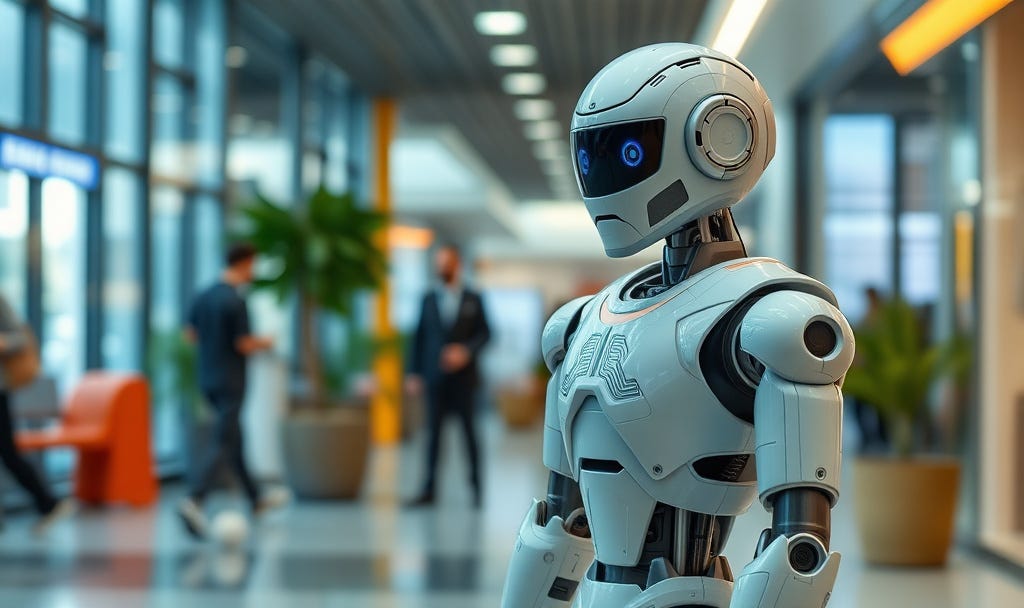
The world’s biggest technology companies have kicked off 2026 with announcements of ambitious plans to further develop AI for the physical world, and especially in the field of brains for robots and humanoids. Two more announcements that are noteworthy come from Microsoft, and AsiaInfo and ABB Robotics.
Microsoft has introduced Rho-alpha, a new robotics model that aims to bring the generative-AI revolution from text and images into the physical world. Built on the company’s Phi series of vision-language models, it is designed to translate natural-language instructions into control signals for dual-arm robots performing complex manipulation tasks.
Rho-alpha is described as a “vision-language-action-plus” system, adding tactile sensing to the usual camera and language inputs and with plans to incorporate force and other modalities. Microsoft is trialling the model on dual-arm and humanoid platforms and is inviting organisations to apply for an early-access programme, ahead of broader availability through its Foundry offering.
The launch underscores how big technology firms are racing to turn large AI models into “physical AI” platforms that can perceive, reason and act among humans, not just generate text or images. As labour markets tighten and factories, warehouses and hospitals hunt for productivity gains, adaptable robots that can learn from feedback and cope with messy real-world environments have become a strategic prize.
“Through these advancements, we aim to make physical systems more easily adaptable, viewing adaptability as a hallmark of intelligence,” Microsoft’s research team wrote. “We believe robots that can adapt more easily to dynamic situations and to human preferences will be more useful… and more trusted by the people who deploy and operate them.”
AsiaInfo, ABB Robotics team up
Meanwhile, AsiaInfo and ABB Robotics have launched a new “Embodied Intelligence Laboratory” in China, betting that “physical AI” will be the next frontier in industrial automation. The lab was formally inaugurated on Jan. 25 and is positioned as the practical outgrowth of the two companies’ existing strategic partnership.
Backed by Alibaba Cloud and Nvidia, the laboratory will blend AsiaInfo’s strengths in AI applications, 5G-A communications and cyber security with ABB’s know‑how in robot control. The partners plan to focus on industrial simulation and physical AI built on Alibaba Cloud’s vision‑language‑action large model and Nvidia’s simulation platform, targeting deployment in complex factory environments.
The tie‑up underlines how Chinese software, Western industrial automation and US chip design companies are converging around embodied intelligence as manufacturing digitises at speed. As factories push to cut labour costs and cope with ageing workforces, vendors from ABB to Alibaba and Nvidia are racing to turn generative and embodied AI into robots that can perceive, decide and act reliably on the shop floor.
“The Laboratory may serve as a key platform for their continuous enhancement in technological synergies and co-creation of application scenarios, with a view to advancing the implementation of the application scenarios of physical AI in manufacturing sector and setting an industry intelligence benchmark with global influence,” AsiaInfo’s board said.