
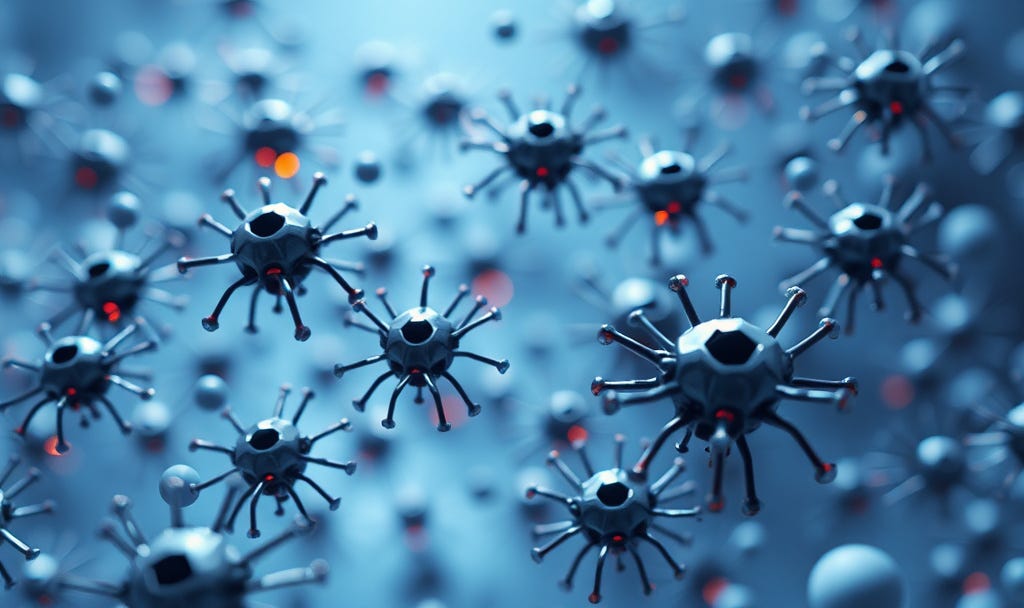
Microscopic robots the size of single-celled organisms are edging closer to practical use, as researchers demonstrate cell-powered machines that can sense their surroundings, run simple programs and change course without human supervision. Built using standard chip-manufacturing techniques, the devices suggest that autonomy at the microscale may soon be as much an information-processing challenge as a mechanical one.
Engineers at the University of Pennsylvania and the University of Michigan have built sub-millimetre robots — roughly 210 by 340 by 50 micrometres, comparable to a paramecium — that integrate photovoltaic power, temperature sensors, memory, a processor, optical communications and electrokinetic actuators on a single chip. Each robot can be mass-produced lithographically, with yields above 50 percent, and in principle could be manufactured for about a cent apiece at scale.
For four decades, micro-robotics has promised swarms of machines swimming through blood vessels, patrolling industrial process lines or mapping microscopic ecosystems, but has been held back by the inability to shrink computation, power and locomotion into volumes below a cubic millimetre. Most existing micro-robots are either tethered to bulky external control systems, or hard-wired for a handful of fixed behaviours, limiting deployment beyond carefully controlled laboratories.
By moving a fully fledged, if tiny, computer onto the robot itself and powering it with light, the new work points to a future in which general-purpose micro-robots can be cheaply programmed and reprogrammed to carry out diverse tasks in messy environments — from targeted drug delivery to nano-manufacturing — without custom hardware each time.
“By moving computation to the micro-robot, we reduce both the cost and operational overhead to a bare minimum, paving a path to widespread adoption,” the authors write, arguing that versatile, penny-priced machines could ultimately find uses from microsurgery to studies of living systems.
To squeeze autonomy into a power budget of about 100 nanowatts, the team designed a custom complex-instruction-set processor in a 55-nanometre CMOS process, paired with a few hundred bits of onboard memory. Specialised commands such as “sense temperature” or “move for N cycles” compress dozens of low-level operations into single instructions, allowing the robots to execute useful behaviours despite their tiny program space.
Immersed in fluid, the bots propel themselves by driving current between platinum electrodes, generating electrokinetic flows that translate and rotate the chip at speeds of around 3–5 micrometres per second in straight motion and up to 0.3 degrees per second when turning. In thermal-gradient experiments, the robots measured local temperature, compared it with prior readings and switched between arcing searches and on-the-spot rotations to climb toward warmer regions, reporting temperatures with a resolution of about 0.3°C in less than 1 cubic millimetre — performance that Pareto-dominates current miniature digital thermometers.