
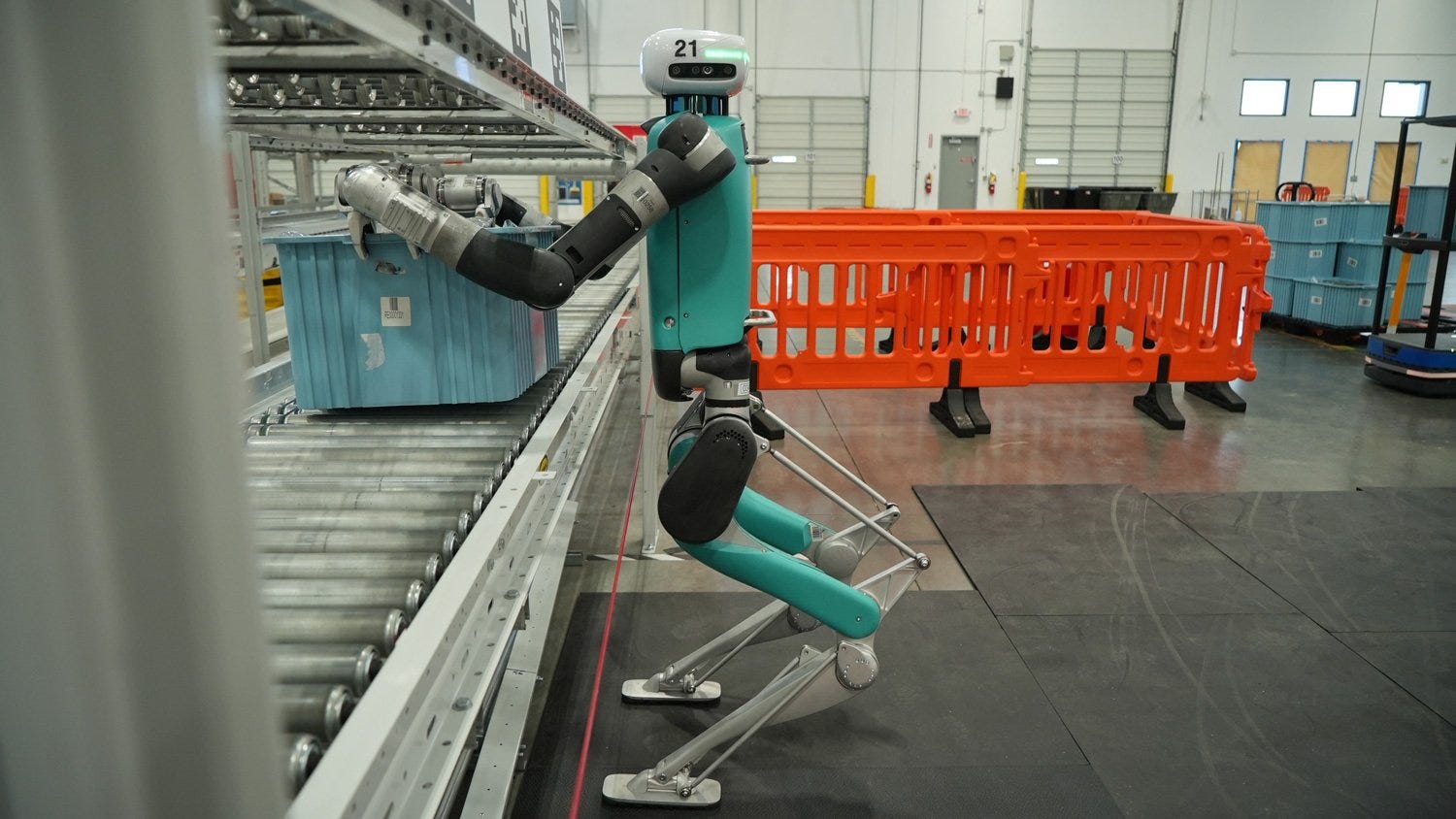
Agility Robotics, maker of the bipedal robot Digit, has signed a commercial robots-as-a-service agreement with Toyota Motor Manufacturing Canada (TMMC), turning a recent pilot into a full deployment at the carmaker’s plants in Ontario.
Digit units will be introduced to lines involving manufacturing, supply-chain and logistics tasks, with the aim of easing physical strain on workers and streamlining shop-floor operations, the Oregon-based robotics company said in a press release.
The deal follows a trial at TMMC’s Cambridge facility and will see humanoid robots integrated into existing workflows rather than driving costly retooling of production lines. Agility says its Digit platform and Agility Arc cloud software can be slotted into current layouts to handle monotonous, process-automated jobs that are hard to staff and retain, from repetitive material handling to backroom logistics. The humanoid robot economics behind deployments like this one, including payback periods and cost projections, are explored in our manufacturing analysis.
Humanoid robots have become the latest frontier in factory automation as manufacturers confront ageing workforces, labour shortages and pressure to raise productivity without sacrificing safety. Agility already counts Amazon, GXO and Schaeffler among its customers, and is pitching Digit as a general-purpose, “human-centric” machine that can walk where people walk and adapt to changing workflows using artificial-intelligence tools.
For global automakers such as Toyota, whose Canadian arm runs its largest production operation outside Japan, humanoids offer a way to automate ergonomically risky or low-value tasks while preserving the company’s long-cultivated “Respect for People” ethos on the line.
“Toyota Motor Manufacturing Canada has long been a leader in automotive manufacturing innovation,” said Tim Hollander, TMMC’s president. “After evaluating a number of robots, we are excited to deploy Digit to improve the team member experience and further increase operational efficiency in our manufacturing facilities.”
Beyond the initial rollout, Agility and TMMC plan to assess further use cases where robots and AI could augment automotive production, particularly in extremely repetitive and physically taxing jobs. Agility’s chief executive, Peggy Johnson, said the company’s next generation of Digit is intended to be the first “cooperatively safe” humanoid designed to work alongside people, enabling customers to scale deployments beyond fenced-off automation cells.
Agility argues that, as its robots learn new tasks and adapt on the fly, they will become a flexible layer of automation that can be reallocated as product mixes and production schedules shift.

