
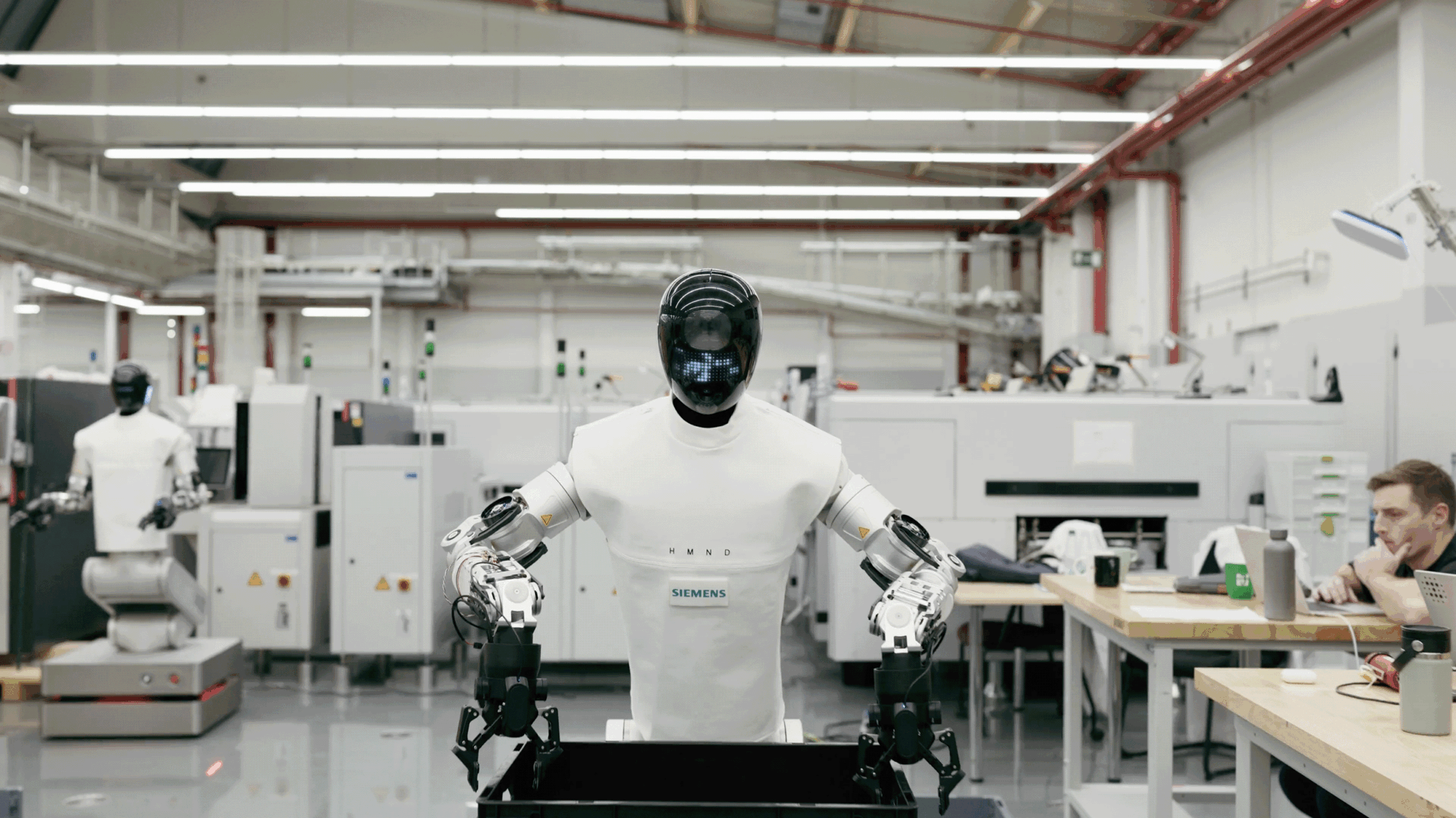
Humanoids have begun to step into factories and warehouses in scenarios closer to real-world applications. Earlier humanoid robot deployments were largely confined to demonstrations, but the gap between lab and factory floor is closing. Recent high-profile deals such as the one between Toyota and Agility Robotics reflect the trend. Toyota Motor Manufacturing Canada has signed a Robots-as-a-Service agreement to deploy seven of Agility’s humanoid robots in manufacturing at its Woodstock, Ontario facility. Agility has also expanded its customer base in e-commerce, including a warehouse automation push by Mercado Libre in Latin America.
At BMW Group’s Spartanburg plant in the US, over ten months in 2025, Figure AI’s Figure 02 robot worked alongside human employees on the BMW X3 production line, completing approximately 1,250 operating hours and moving more than 90,000 components. The robot handled precise positioning of sheet metal parts for welding — a task requiring millimeter-level accuracy while being physically demanding for human workers. Within that period, it contributed to the production of 30,000 vehicles.
BMW has just announced that it is bringing robots and physical AI to some of its German plants.
These deployments also reveal how humanoids are being used currently. All involve structured, repetitive tasks in controlled environments. Material handling tasks dominate, including moving bins, positioning components, transporting totes between stations and so on. No manufacturer is deploying humanoids for assembly operations, welding cells, or machine tending — tasks that would require greater dexterity and adaptability.
Humanoid robot costs and ROI
The case for humanoid robots is gradually but increasingly supported by the math. A manufacturing worker in the US costs approximately $160,000 annually when wages, benefits, overhead, and payroll taxes are included. Current humanoid robot prices range from $13,500 for basic models like the Unitree G1 to $250,000 for more capable systems like Agility’s Digit.
At these prices, the payback period for replacing a single-shift worker ranges from two months for the least expensive models to nineteen months for premium units.
Multi-shift operations improve the economics further. A robot operating sixteen hours daily can effectively replace two workers at a combined cost of $320,000 per year. Maintenance, software updates, and integration costs add 50-100 percent to the purchase price, but the basic calculation remains attractive for high-wage environments.
In regions where labor costs are lower, or where existing automation solutions remain cost-effective, the business case weakens. The appeal of humanoid robots derives partly from their ability to work in facilities designed for human workers, avoiding the expense of redesigning production lines. But this advantage matters most in brownfield sites with space constraints or frequent reconfiguration needs.
The bill of materials for a humanoid could drop from the current $40,000 to $50,000 to $10,000 to $20,000 by 2035, the consultancy Bain & Co. projects.
Technical limitations of current humanoid robots
Current humanoids excel at mobility and basic manipulation in mapped environments but struggle with fine motor tasks requiring tactile feedback. Battery life remains limited — most industrial humanoids operate for 4-8 hours before requiring recharge. Reliability under continuous operation is improving but not yet proven over multi-year timeframes.
Safety certification for fenceless operation alongside human workers represents another hurdle. Most current deployments operate in semi-segregated zones or during off-hours when human presence is minimal. Agility Robotics has stated its next-generation Digit will be the first cooperatively safe humanoid capable of working directly alongside people at scale.
BMW notes that while motion sequences trained in the laboratory transferred to production faster than expected, early involvement of production IT infrastructure, occupational safety, process management, and shop floor logistics teams proved essential. Integration with existing manufacturing execution systems and warehouse management platforms requires substantial engineering effort.
Bain and Company’s research indicates that humanoid adoption will occur in three waves: industrial applications in automotive, mining, and construction first; then commercial uses in cleaning, healthcare, and hospitality; finally, consumer applications in domestic settings. The trajectory depends on technology maturation but also on measurable return on investment and building user risk tolerance.
From pilots to scale
The current landscape features many pilot programs, partnerships and testing agreements. It remains to be seen how many of those will transition to commercial deployments of hundreds and then thousands of humanoid robots.
Manufacturing executives require proof of reliability over extended periods — preferably years, not months. They need evidence that humanoids can match the uptime of existing automation solutions, which often exceed 95 percent. Questions about service and support networks, spare parts availability, and long-term vendor viability weigh heavily in capital equipment decisions of this magnitude. For context, a transition from pilot to meaningful scale would likely mean fleets of 50 or more units operating continuously across multiple shifts, a threshold no manufacturer has publicly reached with humanoid robots as of 2025.
The industry also faces a coordination challenge. Humanoid robots, unlike most other manufacturing technologies, lack established supply chains with tiered manufacturers building standardized modules. Each company develops its own actuators, control systems, and AI models. Some suppliers are beginning to address this by developing standardized humanoid components for use across multiple platforms. This vertical integration may accelerate innovation but creates vendor lock-in and complicates maintenance for end users operating multi-vendor fleets.
Humanoid robots are entering commercial use, but years away from scale deployment in most manufacturing environments. Even as they are being used for genuine industrial applications, deployments at scale are some years away.
Widespread adoption will require significant cost reductions, demonstrated multi-year reliability in production settings, expanded dexterity for complex manipulation tasks, and standardized safety certifications for human-robot collaboration. Progress on all fronts is happening, but unevenly.